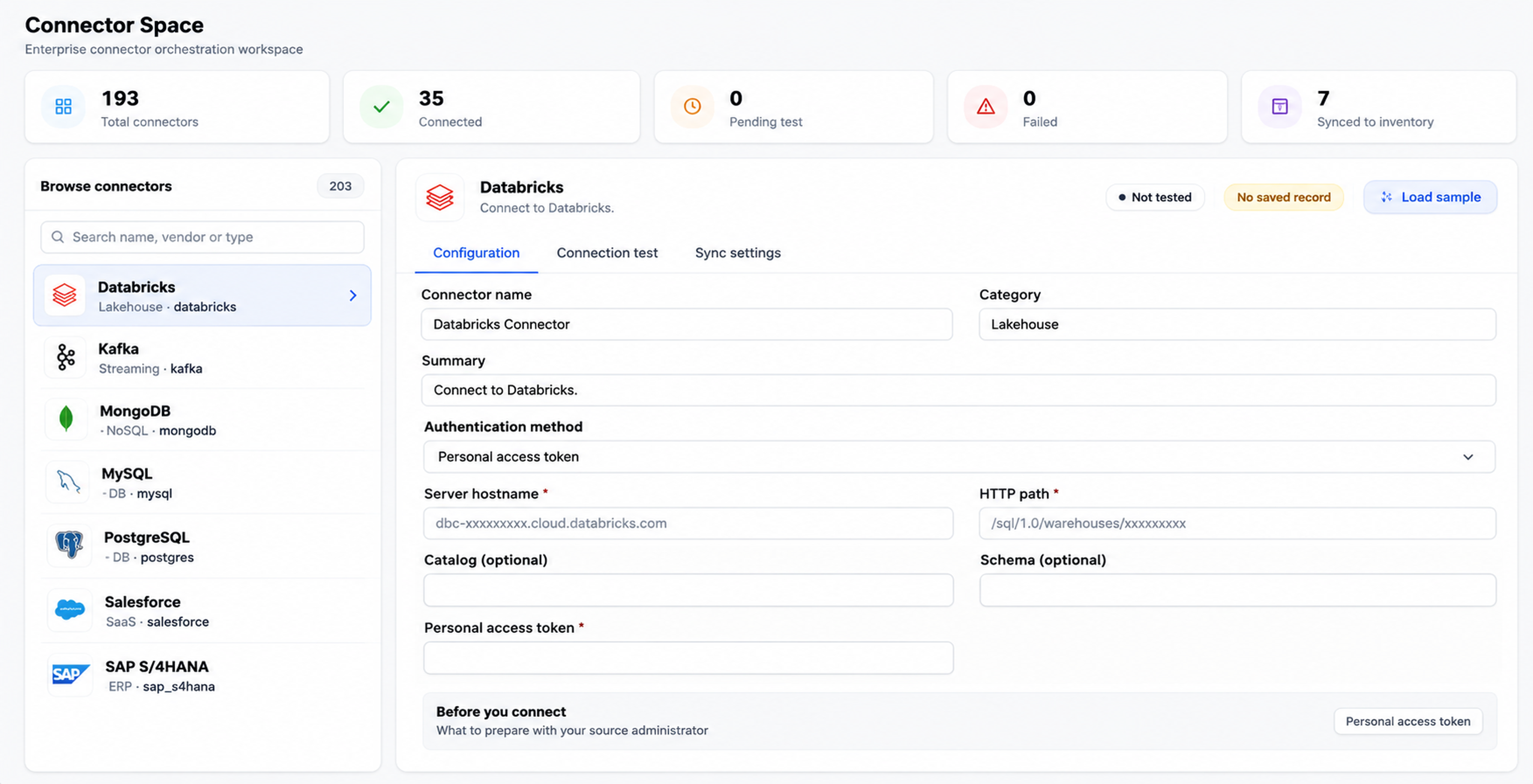
Configure supported databases and enterprise connectors, test connections and sync source metadata to your inventory.
Start by registering the systems that hold your structured data. Connector Space keeps configuration, connection tests and inventory synchronization together, so teams can establish which sources are ready for discovery.
Configure source access
Review connection health
Sync to source inventory
What you getA source inventory with connection status and metadata to guide discovery.
DIAS brings document sources and uploads into discovery. Review processing status, classifications and findings to understand the information your files contain.
Documents can hold personal information outside database tables. DIAS manages connected document repositories and uploaded files, with processing status and scan history to help teams investigate findings in their source context.
Connect document sources or upload files
Review file processing and scan status
Investigate sensitive-data findings
What you getDocument-level visibility into sensitive information and the files that need review.
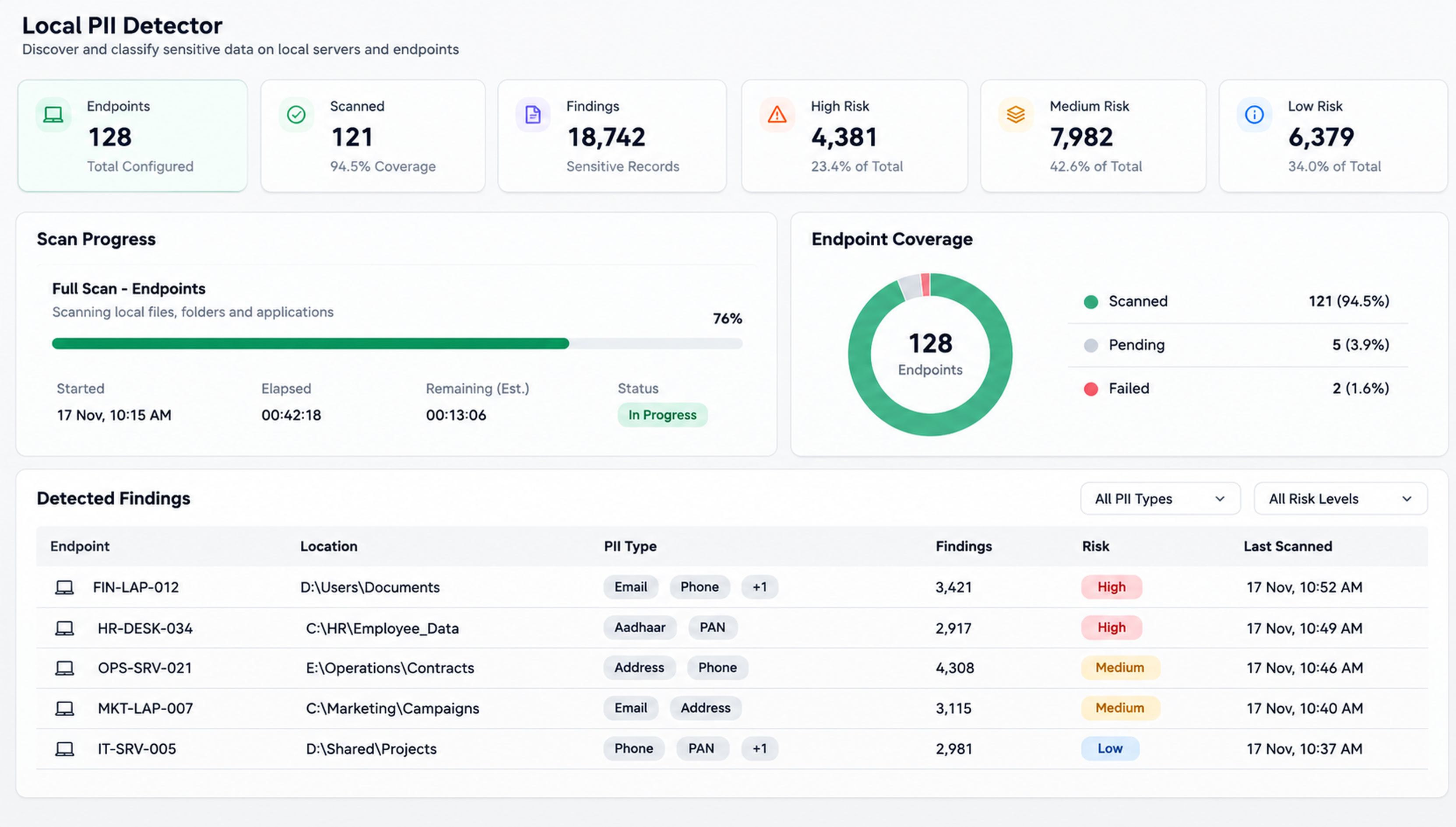
Use agent-based scanning to locate sensitive data on local servers and endpoints. Review scan progress and findings by location, PII type and risk.
Sensitive files can also sit on local servers and employee endpoints. The Local PII Detector uses an agent-based approach to scan agreed locations and bring endpoint coverage, scan progress and detected information into a reviewable view.
Track endpoint coverage
Locate sensitive files and findings
Prioritize high-risk results
What you getA location-based view of endpoint findings, grouped by information type and risk.
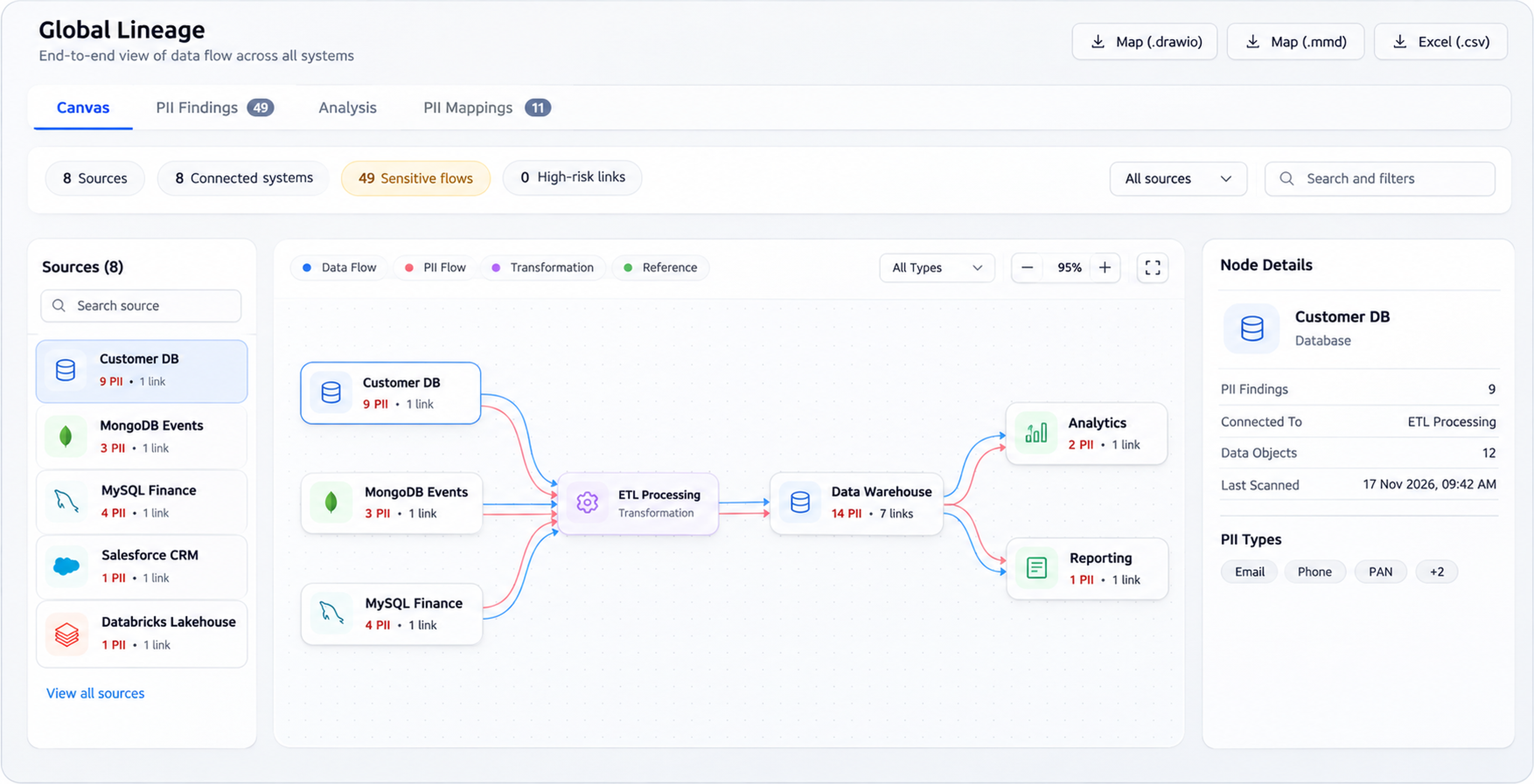
Trace relationships across sources, transformations and downstream systems. Inspect connected assets and sensitive-data flows with their surrounding context.
A finding is more useful when you can see where the data comes from and where it goes. Global Lineage connects source assets, processing steps and downstream uses in a shared canvas, with node details and PII flows for closer investigation.
Explore cross-source relationships
Follow data and PII flows
Inspect source and node details
What you getA connected view that helps teams assess dependencies and sensitive-data movement.
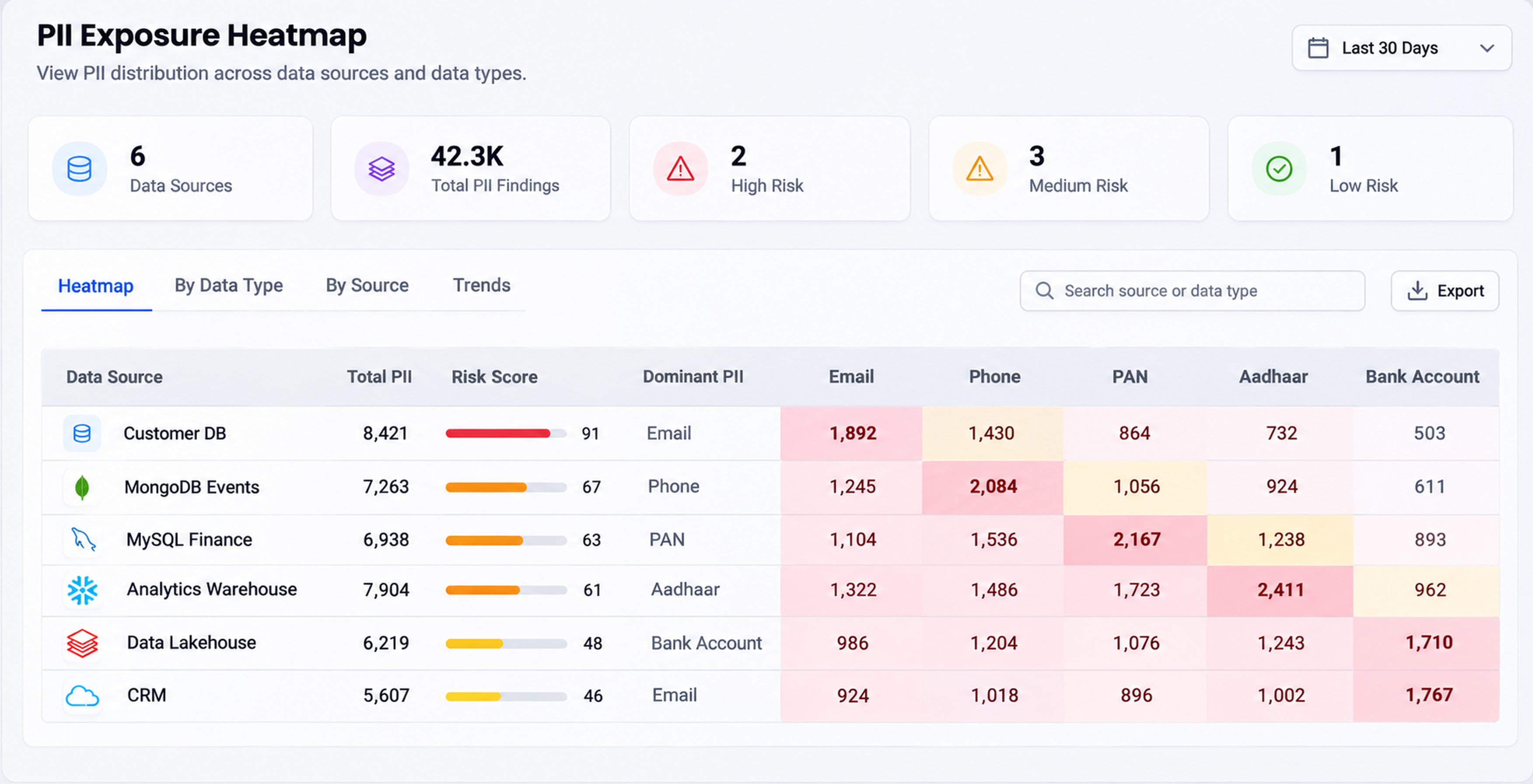
Compare PII distribution across sources and data types. Use risk scores and exposure patterns to focus your next review.
Bring the findings into a source-by-source comparison. The heatmap highlights concentrations of personal information and the dominant data types, giving privacy and governance teams a practical starting point for investigation.
Compare exposure across sources
Review dominant PII types
Focus on higher-risk areas
What you getA prioritized view of exposure to support review and remediation planning.
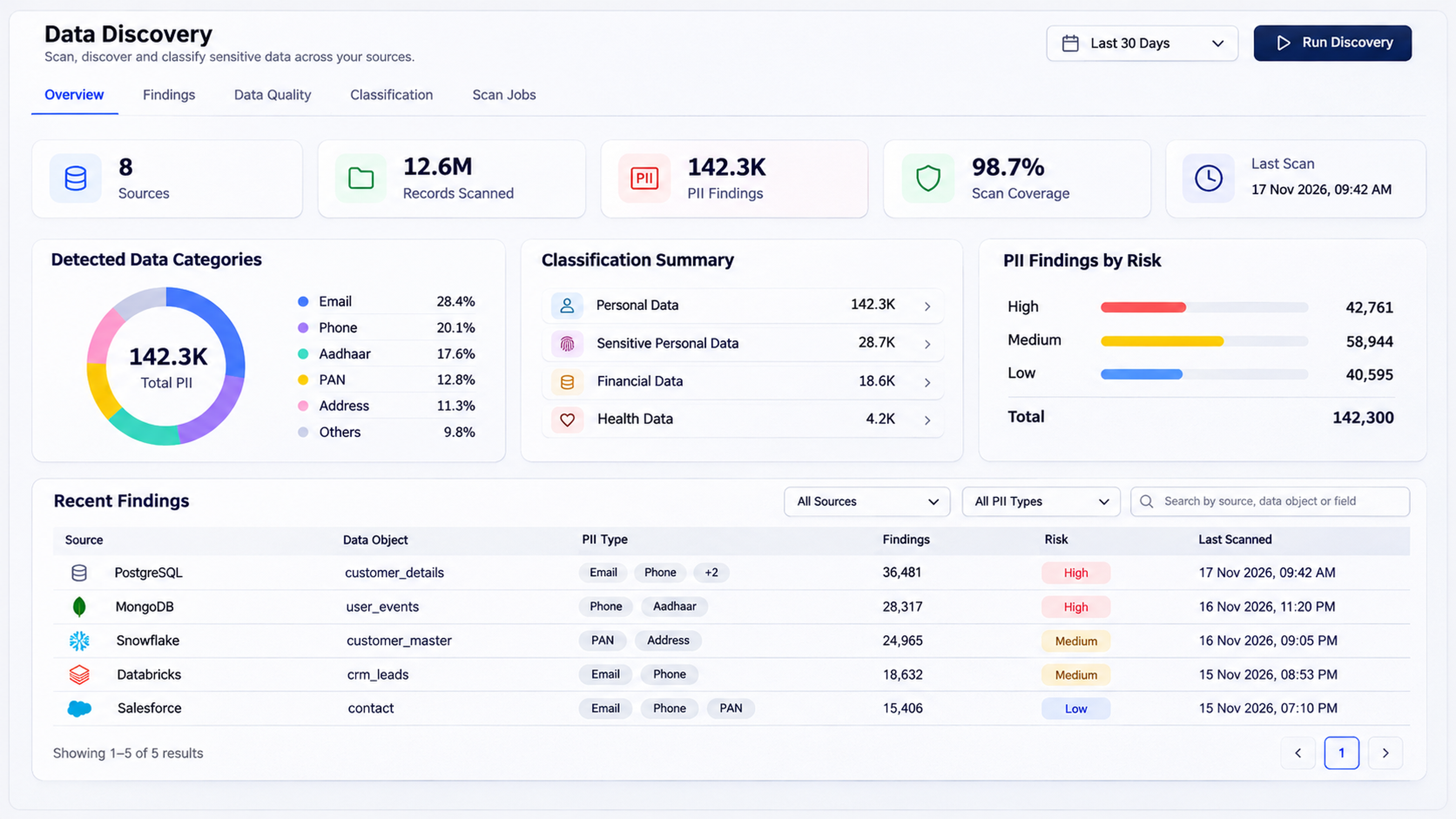
Supplied DataSense product views. Select any image to inspect it at full size. Figures shown are illustrative of the supplied views, not performance benchmarks.
The enterprise challenge
See the information behind the systems.
Your enterprise holds millions of records across databases, applications, documents, cloud environments, and employee systems. Somewhere within that complexity lies sensitive information that needs to be discovered, understood, and governed.
Whether you are preparing for India's DPDP requirements, strengthening information governance, or building an enterprise-wide data inventory, DataSense gives your teams the visibility to move forward with confidence.
Product capabilities
Discover the intelligence hidden in your enterprise
Personally identifiable information (PII), records of processing activities (ROPA), role-based access control (RBAC), and software as a service (SaaS).
Discover without boundaries.+
Personal information rarely lives in one place.
DataSense supports discovery across structured databases, unstructured files, enterprise applications, cloud repositories, and supported endpoints.
Find sensitive information wherever it resides, reduce blind spots, and create a clearer picture of your data landscape.
Structured discovery
Unstructured scanning
Cloud repositories
Enterprise endpoints
Source inventory
Classification that goes beyond keywords.+
Not every sensitive record looks the same.
DataSense combines configurable detection patterns, dictionaries, and intelligent classification to identify personal and sensitive information across different data formats.
Understand what was discovered, where it exists, and how it should be categorized.
PII detection
Sensitive data classification
Custom dictionaries
Confidence indicators
Classification evidence
Every source. Every relationship. One clearer picture.+
Data becomes more valuable when its context is understood.
Connect discovered metadata with business definitions, system ownership, documented relationships, and processing activities.
Move from isolated scan results toward a meaningful understanding of your enterprise information landscape.
Data inventory
Business glossary
Data mapping
Lineage
ROPA
From discovery to continuous awareness.+
Data environments never stand still.
New records appear. Systems change. Sensitive information moves.
DataSense supports scheduled and incremental discovery to help organizations maintain updated visibility, identify changes, and keep governance evidence relevant.
Scheduled scans
Incremental discovery
Scan history
Dashboards
Reporting
Designed for enterprise control.+
Your data should remain under your control.
DataSense supports deployment architectures suited to different enterprise requirements, including on-premises environments and customer-side scanning patterns designed to limit the movement of sensitive information.
Security, access governance, auditability, and deployment requirements can be aligned to your organization's operating environment.
RBAC
Audit logging
Encryption controls
On-premises deployment
Metadata-only SaaS architecture options
The DataSense advantage
See the unseen.
Find sensitive information across disconnected enterprise environments.
Understand the connections.
Bring technical metadata, business context, and governance evidence together.
Govern with confidence.
Turn discovery insights into informed privacy and governance decisions.
Know your data. Own your intelligence.
Stop relying on assumptions about where sensitive information exists. Build your governance strategy on evidence.


 Connector SpaceView full size ↗